Karya I Made Andi Arsana, ST., ME Batas Maritim Antarnegara - Sebuah Tinjauan Teknis dan Yuridis (Gadjah Mada University Press, 2007) more...

Thursday, July 14, 2005

Excercising Maritime Boundary in Timor Sea

Robust Equidistance Line
Figure bellow depicts equidistance lines in Timor Sea that consist of two different segments. Segment CB4-a is the adjacent equidistance line between West Timor and Timor Leste, and is the elongation of land border in Mota Masin. Segment b-c represents the median line between Timor Leste and the Indonesia’s archipelagic straight baseline along Pulau Leti, Pulau Moa, Pulau Lakor, Pulau Maetimearang with zero effect given to Pulau Jako. On the other hand, segment b-d is similar to segment b-c only with full effect given to Pulau Jako.


Final Boundary Line
To finalize the boundary in Timor Sea, especially the one starting from the point between Pulau Jako and Pulau Leti going down to the boundary between Indonesia and Australia, half effect has been given to Pulau Jako. The blue line between two black lines is the final boundary line in Timor Sea at the East side. Meanwhile, the equidistance line departing from Mota Masin at the West side of Timor Sea has been left without any shift. This is because there is no significant feature to consider and neither relevant circumstance that influence the equidistance line. The following Figure shows the final boundaries in Timor Sea.

More...

Excercising Maritime Boundary in Ombai Strait

Robust Equidistance Line
Equidistance lines in Ombai Strait shown in figure bellow consist of four segments. The first segment is the line starting from common basepoint CB1 to point a, which represents the equidistance line between Oecussi and West Timor as the elongation of land border in Noel Besi. The second segment is the a-b segment, representing median line between Pulau Batek and Oecussi with full effect given to Pulau Batek. Segment b-c is the median line between Oecussi and Indonesia’s Pulau Pantar and Pulau Alor. Similar to the first segment, the last segment of c-CB2 is the equidistance line between Oecussi and West Timor, as the elongating of land border in Noel Meto.


Final Boundary Line
The maritime boundary in Ombai Strait, as depicted in figure bellow, has been obtained by changing the effect given to Pulau Batek. The significance of Pulau Batek is lower than that of Oecussi; therefore the weight given to Pulau Batek is lower than Oecussi. In this case, half effect (0.5) is given to Pulau Batek that causes the median line shifts toward it. Consequently, Oecussi possesses larger maritime zone than before.

More...

Thursday, June 23, 2005

Sea Territory an Agenda Item for Regional Elections

I Made Andi Arsana [The Jakarta Post] The local leadership elections currently taking place are one of the most important current issues in Indonesia.

This article will not dwell on the politics behind the elections or issues of democratization, but instead look at the powers of local governments as regards maritime territory.

A candidate standing in a local election needs to fully understand the rules governing maritime territory, aside from other important matters, as two-thirds of the country consists of ocean. [read ...]

More...

Exercising Maritime Boundaries in Wetar Strait

After a long time sleep, I finally started exercising the maritime boundary delimitation between Indonesia and Timor Leste as the main research of my master study. The first boundary location exercised was Wetar Strait situating in the sea area between Wetar Island and eastern part of Timor Island, which belongs to Timor Leste. The existence of Pulau Atauro (of Timor Leste) between Pulau Wetar and Pulau Alor (of Indonesia) makes this exercise challenging. As Pulau Atauro is an island, it is entitled to a 12 nautical mile of-territorial sea. Therefore a segment of Indonesian archipelagic straight baseline that departs from a basepoint in eastern edge of Pulau Alor to a basepoint in the western edge of Pulau Wetar cuts the territorial sea of Pulau Atauro. This is most likely not preferable to Timor Leste and consequently has to be considered. In this case, the segment of archipelagic straight baseline can be ignored.


This figure shows the configuration of baselines, territorial sea limits and boundary line between Indonesia and Timor Leste in Wetar Strait. As seen above, Indonesia employs the archipelagic straight baselines (black lines) while Timor Leste uses normal baselines. The green lines are coast lines, which, for Timor Leste, also serve as normal baseline. The orange lines represent territorial sea limit of both states and the blue line is the boundary. Some segments represent territorial sea boundaries while some others depict the EEZ boundaries.

More...

Friday, June 10, 2005

The Jakarta Post's Ambalat Revised: The way forward?

More...

Friday, June 03, 2005

Securing the Sea Territory: Another Agenda in the 2005 Regional Elections

I Made Andi Arsana1, Sydney

Regional leadership election, which Indonesians refer to as PILKADA, is one of the most popular current issues in Indonesia. Those residing outside Indonesia can easily get updated by surfing the Internet. Among the news, most of them concern the issue of politics and democracy, ranging from the campaign of candidates across villages and the emergence of money politics, to the original sin of the new system. This article will not, in particular, highlight the politics and democracy but the regional authority in the sea territory (hereinafter referred to as sea territory). A candidate in the election has to comprehensively understand the rule of sea territory, aside of other important matters because two third of the country is marine area, which is exploitable for the prosperity of the people across the nation.

The first fundamental matter of which a candidate should be aware is the change of regulation dealing with regional government in Indonesia, from the Law No. 22/1999 to be the Law No. 32/2004. With regards to sea territory, these two laws differ quite significantly. The Law No. 22/1999 states “the area of Provincial Regions ... shall consist of inland area and marine area of twelve nautical miles measured from the coast line ...”. As argued by Prof. Jacub Rais, this is a definition of "territory", which regions interpret that there exist provincial sea and regency sea. This can potentially cause conflict of territory possession and natural resource exploitations. The regulation is intended to demarkate the authority between regional and central government, not necessarily to divide territory. This has been clarified in the Law No. 32/2004 by mentioning “the authority to manage the resources in the sea territory”, not “to possess provincial or regency sea”. It is worth emphasizing that the authority mentioned is only to manage resources not to fully posses the sea territory. This is different from that regarding land territory.

Law No. 32/2004 also emphasizes explicitly the fishing activities undertaken by traditional fishermen. It is explained that such activities are not limited by the arrangement of sea territory. In the other words, fishing conducted by traditional fishermen can be done regardless of the existence of a maritime boundary between regions. However, a governor or regent has to be critically aware of the definition of “traditional fishermen” to avoid potential inter-region conflicts in the future.

A few weeks ago, Kompas stated that Maluku, one of Indonesia’s provinces, asked for special maritime autonomy. Kompas argued that Maluku, geographically dominated by sea territory, deserves special authority to manage its sea territory. Minister of Department of Marine Affairs and Fisheries, Freddy Numberi has since positively responded to that claim. What a good news! This, once again, reminds us that it is truly essential for regional governments to secure their authority in the sea territory as it strongly influences their authority to utilize natural resources. As a part of an archipelagic country, a regency/municipality, the main holder of autonomy, is entitled to optimally (but wisely) exploit maritime resources.

The Law No. 32/2004 also states that each province is entitled to manage sea territory of 12 nautical miles (NM) measured from its outermost point. A regency, on the other hand, may claim one thirds of that of province. It is worth emphasizing that it is one third, not necessarily 4 (four) NM, as mentioned incorrectly in Kompas (8 May 2005), “Masyarakat Maluku Minta Otonomi Khusus Kelautan”. This means that if it is not possible for a province to claim up to 12 NM of sea territory, neither can a regency/municipality claim 4 NM. With regards to this, the Law No. 32/2004 does not state “4 NM” but “1/3 (one third) of the provincial authority” (article 18). This principle is crucial, since in defining sea territory, it is highly possible a province cannot fully claim 12 NM. Bali and East Java, for instance, could not claim 12 NM sea terriroty in Bali Strait, as its breadth is less then 12 NM. It is different from South Kalimantan, which can easily claim the breadth of 12 NM to the archipelagic water between Kalimantan and Java Islands.

Unfortunately, there is yet no technical guidance to employ those rules regulated in the Law No. 32/2004. Consequently, no formal technical standards have been created to arrange regional authority in the sea territory. However, it is worth noting that there has been a similar guide written based on the Law No. 22/1999 that may be comparable to look at. Given that the guidance is referenced to the UN Convention on the Law of the Sea 1982, it should still be relevant to be applied under the regime of the law No. 32/2004, at least until a new guidance is produced.

The guidance was one of the publications of the Coastal Resource Management Project (CRMP), written by Prof Jacub Rais in 2003 as one of the experts. The project was conducted by the Indonesian Government in collaboration with Coastal Resources Center University of Rhode Island (US) and funded by the USAID. Fundamental matters outlined in the guidance are the definition of adjacent and opposite province; the use of datum or reference for height definition; definition of bay; baselines and basepoints; the case concerning small island and fringing islands; the choice of chart; and administrative aspect regarding the stipulation matters.

Understanding the concept and regulation in defining the sea territory is an important agenda for a candidate in the 2005 regional election. With autonomy, a regional leader is expected to be able to optimally manage and exploit regional potency. Without comprehensive understanding, governors or regents will not be aware of the limit of maritime area they can utilize. How can they optimize the resource exploitation without an awareness of territory? So, if you happen to attend a campaign for election, do not forget to ask the candidates their strategy in securing the sea territory.

Footnotes
1Lecturer in the Department of Geodetic Engineering, UGM, currently studying technical aspects of Maritime Boundary at the University of New South Wales, Sydney

More...

Tuesday, May 31, 2005

Acceptance Letter for Paper Presentation at Map Asia 2005

Dear Mr. I Made Andi Arsana

We take the pleasure to inform you that your paper “AMBALAT: A Spatial And Technical Perspective” has been accepted by the Map Asia 2005 review committee to be presented Orally during the Technical Session on " Coastal Zone Management " during Map Asia 2005, to be held during 22 - 25 August 2005, in Jakarta, Indonesia. The Technical Session is subject to change depending on the final Programme schedule

We would also appreciate if you could arrange to send the Full manuscripts of your presentation to be made at Map Asia 2005 before 15th July, 2005 to enable us to incorporate it in the conference proceedings to be released on the occasion of the conference.

For further correspondence kindly refer to your Paper as: PN 043

It may kindly be noted that on acceptance of the full paper, the author needs to accept the terms and conditions laid down in the Copyright & Author's agreement.This agreement shall be mailed along with the acceptance notification of the full paper.

Looking forward to your participation in Map Asia 2005.

Kind Regards

Shivani Lal (Ms.)

More...

Friday, May 27, 2005

Problem with Geo-referencing

It has been so long since my last posting about my research (read: my thesis). I have been spending so much time to play with other issues including Ambalat. However, it is an important moment for my academic career path!

So, it is the time to get back to Timor Leste issue.

Data
I have collected data from Bakosurtanal and Dishidros but unfortunately none of the data is in vector format. Bakosurtanal gave the nautical chart of Timor Island in Adobe Illustrator format that is convertable into TIFF. In my hand now are some files in TIFF depicting Timor Island in some different sheets.

Image Registration
In order to be able to process the data using CARIS LOTS, it has to be geo-registered. This is a standard proces in dealing with image data that has not yet geo-referenced.
Good news, CARIS is equipped with that kind of function so, this can be ,theoritically, done easily. However the actual process has never been as simple as the plan. The TIFF image after being imported into CARIS did not appear clearly so it was really difficult (if not impossible) to process the registration. How could you pick the common control points if you can't even see the image clearly? The only thing shown was a black image illustrated bellow.


What to do next?
After googling for days and trying many possibilities, I finally came up with a solution. There was something to do with the compression. The image has to be compressed using LZW & Differencing. I did it using Microsoft Photo Editor. Thanks to Uncle Bill Gates! :) The image could then be easily imported into CARIS to be registered. The next process are to define the basepoints and simulate the boundary line possibilities.


Have you had a similar experince with registration? Try this!

More...

Friday, May 20, 2005

Abstract for Map Asia 2005

AMBALAT: A SPATIAL AND TECHNICAL PERSPECTIVE

I Made Andi ARSANA1
School of Surveying and Spatial Information Systems
The University of New South Wales
madeandi@student.unsw.edu.au

Dr Clive SCHOFIELD2
Center for Maritime Policy
University of Wollongong
clives@uow.edu.au

Abstract

During March 2005, the bilateral relationship between Indonesia and Malaysia deteriorated. This was primarily related to competing claims to the “Ambalat offshore area” located in the east of Borneo Island in the Celebes (Sulawesi) Sea.

The dispute resulted in strong reactive responses in both countries, but particularly in Indonesia. This is understandable as many Indonesians generally believe that the dispute deals with sovereignty and are concerned over further territorial losses in the aftermath of Malaysia’s victory in the case concerning Sipadan and Ligitan islands with Indonesia in 2002. Regardless of reasons the International Court of Justice (ICJ) provided, most Indonesians were simply disappointed. Since issues of international boundaries, territory, sovereignty and sovereign rights are highly sensitive, it is important for all concerned from both countries have to really understand the scientific, technical, and legal dimensions of any dispute.

This paper discusses the case of Ambalat in a spatial and technical perspective. Simulations have been done exercising the maritime claims of Indonesia and Malaysia in Celebes Sea using global chart data. GIS software, CARIS LOTS™, was utilized as an assisting tool to technically generate baselines, maritime zone limits and maritime boundary lines for the two countries. The simulations spatially show the change of Indonesia’s baseline due to the ‘loss’ of Sipadan and Ligitan islands that consequently change the boundary. Conclusions are then drawn as to the relative merits of each State’s claims to Ambalat and the prospects for resolution of the dispute.

Keywords: sovereignty, baselines, maritime zones, maritime boundaries, GIS, dispute

Footnotes
1A Lecturer at Department of Geodetic Engineering, UGM, currently studying technical aspect of International Maritime Boundaries at the University of New South Wales, Sydney, Australia
2Senior Lecturer, Centre for Maritime Policy, University of Wollongong, Australia

More...

Sunday, May 15, 2005

Once again: Ambalat

[Interesting points from Prof Rais]

Prof. Jacub Rais, the father of geodesy in Indonesia, also expressed his opinion about Ambalat. As an expert in maritime issues and toponim he has some interesting points about Ambalat. His complete article can be found in Kompas, 11 April 2005.

Some points are important to note:

  1. Ambalat is the case dealing with sovereign rights, not sovereignty. This is important to understand where we can fully apply full sovereignty and where we can only exercise our rights to explore and exploit natural resource.
  2. Kalimantan is officially unknown. Borneo id its formal geographic name.
  3. Sipadan and Ligitan have never been listed in Djuanda Declaration and neither in Dutch Archive. It is not entirely true saying that we’ve lost the two islands. How could we lose something never belong to us?
  4. Government has not intensively socialized important issues such as UNCLOS, maritime zones, etc.
  5. It is very important to start thinking about marine cadastre to administer our coastal zones, maritime and islets including associated rights, boundary, and obligation.
  6. The administration includes toponim, field survey, mapping the boundaries and publish it in an official publication.
  7. It is essential for government official and people representatives to understand UNCLOS III and how to implement the rule for Indonesia’s needs.
  8. We are not to worry about losing outermost islets but develop the area to reflect government’s responsibility to the inhibitants.
  9. It is not the international boundaries that are important but inter-province boundaries, which has not yet rule and specific guidance. This is a potential conflict in the future.
  10. An ethnic-based division of Indonesian region is not a very good idea since it can retain ethnic sentiment. Prof. Rais suggested a bio-physic consideration such as water shed feature to delineate boundaries between provinces and regencies.
  11. Make marine cadastre not war!

More...

Saturday, May 14, 2005

Seminar and Workshop in Indonesia: a Report to Chris Rizos

Dear Chris,

I am happy, finally arrive back in Sydney. All programs in Indonesia were done well. Here is list of activities and the results

1) 2 May 2005: Arrived in Jogja at 7.15 pm local time
2) 3 May 2005: Seminar "The fragility of Indonesia's Archipelagic Boundaries, Reflection of Indonesian Society to Ambalat"
Clive was one of the presenters, presenting "The Delimitation of Indonesia's Maritime Boundaries". Other Presenters are: Arif Havas Oegroseno (Indonesia's Department of Foreign Affairs), Kol. Laut Drs. Rusdi Ridwan, Dipl.Cart (Indonesian Navy's Hydro-Oceanographic Office), Dr Sobar Sutisna (Bakosurtanal), Hj. Endang Purwaningsih, SH, MH (Law Faculty, UGM), and Drs. Lambang Triyono, MA (enter for Security and Peace, UGM)
I was appointed to be the moderator for Clive and Sobar' session discussing International Boundaries.
Generally speaking, there were interesting sessions in the seminar with 250s audiences coming from universities, national and regional government, professionals and NGOs. Good and hot discussion were generally about Ambalat case. It was surprising that many people thought that Ambalat is an island. The seminar should have been a good time to give better understanding for the laymen.

3) 4 May 2005: Discussion with the Department of Geodetic Engineering (DGE), UGM. I was appointed to be the moderator for three sessions. 1) Djawahir of DGE presented the activities related to land boundary definition between Indonesia and East Timor. Clive at the discussion gave comments and suggestions on some difficulties they faced. 2) Discussion on DGE's new curriculum. DGE plans to create a new lecture in their 2006 curriculum: Boundary Definition. Clive was expected to contribute ideas how the lecture should be structured. Based of discussion, the new lecture should be a complementary lecture to the existing one DGE currently teaching, Geodetic Aspect of The Law of the Sea. 3) Discussion on the possibility to conduct cooperation between DGE, CMP and UNSW, if possible. The issues discussed are the possibility to conduct faculty exchange, student exchange, postgraduate studies, and joint-research. It was concluded that possibilities are open as long as we can secure the funding. Clive suggested to see the possibility to utilize funding from ARC, ADB and World Bank. Other form of cooperation is short course and training as a collaboration among DGE, Australian Institution (CMP, for example) and Indonesian Government ( e.g. Bakosurtanal)

4) 5 May 2005: City tour (Borobudur and Prambanan temple, Sultan Palace, Batik Shopping, Jogja outback visit, Mount Merapi overview)

5) 6 May 2005: Workshop day 1: Legal and Technical Aspects of Maritime Boundary Delimitation. The workshop is officially opened by Matindas, the head of Bakosurtanal. Clive was the only speaker on the day, presenting materials in six sessions. There are about 25 Audiences from universities, Bakosurtanal, Department of Fisheries and Maritime Affairs, NGO, regional Government, etc. Hasan Z. Abidin, Klaas Villanueva, Dr. Khafid, Sobar Sutisna and some other Indonesian Experts also attended the workshop.

6) 7 May 2005: Workshop day 2: Legal and Technical Aspects of Maritime Boundary Delimitation. There were five presenters in five different sessions. In the first session, Sobar Sutisna presented "The role of geospatial data in Boundary delimitation". This is followed by Arif Havas Oegroseno (Dept. of Foreign Affairs) presenting "Maritime Boundary Disputes and Resolution". The third presentation by Klass Villanueva was about "Land Boundary Disputes and equitable maritime Boundary delineation". Material about Indonesia's potential extended continental shelf was presented in fourth session by Dr Khafid (Bakosurtanal). This was followed by the last session where I presented the Introduction of CARIS LOTS™ for Maritime Boundary Delimitation and Dispute Resolution.

Clive and I agree that the Seminar and workshop are good programs and it was a good time to meet Indonesian experts in boundaries. Other thing, Sumaryo, my dept head also suggested me to search for possibilities to continue my study into PhD level.

Thank you!

cheers
Andi

More...

Friday, May 13, 2005

Letter of Acceptance for ICOC 2005


c/- Michele Ford
School of Political and International Studies
Flinders University

3 April 2005

Dear Andi
I am delighted to advise you formally that the abstract you submitted for the Indonesia Council Open Conference 2005 has been accepted.

ICOC 2005 will provide an excellent opportunity for you to spend time with other Indonesianists and to hear about new research. While you are at the ICOC, we would also like to invite you to attend the Flinders Asia Centre Annual Lecture, which is to be delivered on the evening of Monday 25 September by Sidney Jones.

We look forward to meeting you in Adelaide in September, and will contact you periodically before then with the conference program and other information about the conference.

Best wishes
Michele Ford
ICOC 2005 Conference Convenor

More...

Abstract Submitted to ICOC 2005

MARITIME BOUNDARY DELIMITATION
BETWEEN INDONESIA AND TIMOR LESTE:
A TECHNICAL PERSPECTIVE

I Made Andi ARSANA, INDONESIA
The University of New South Wales
madeandi@student.unsw.edu.au
Geodetic Engineering, Gadjah Mada University
madeandi@ugm.ac.id

Clive SCHOFIELD, UK
Centre for Maritime Policy, University of Wollongong
clives@uow.edu.au

Abstract


The 1999 referendum liberated East Timor making it an independent country. As adjacent coastal States, Indonesia and Timor Leste are currently faced with the challenge of delimitating their maritime boundaries. According to Indonesia’s Department of Foreign Affairs, negotiations on this particular matter have yet to start.

This paper aims to provide a preliminary study on how the delimitation of the Indonesia – East Timor maritime boundary could be achieved, focusing on its technical aspects. A number of alternative potential boundary alignments will be examined and analysed in the context of the maritime boundary negotiations between the two States.

The United Nations Convention on the Law of the Sea, LOSC, will provide the main legal reference point, together with relevant state practice and jurisprudence. Technically, potential delimitation lines will be calculated in a geodetically robust manner with the assistance of a specialised Geographic Information Systems (GIS) application. This paper concentrates on specific contextual issues around the definition of the maritime boundaries and explains associated technical terms.

Keywords: maritime boundary delimitation, law of the sea, LOSC

Presenting Author’s Details:
Name : I Made Andi ARSANA
Position : Postgraduate Research Student
Institution/Organization : UNSW, Sydney
Address : 2/10 Houston Road, Kensington
City : Sydney
Postcode : 2033
Country : Australia
Tel : (02) 9662 6023
Fax : (02) 9313 7493
E-mail : madeandi@student.unsw.edu.au

More...

National Seminar: The Fragility of Indonesia’s Archipelagic Boundaries, Reflection of our society for Ambalat

[a small note]

The seminar organized by Gadjah Mada University’s Geodetic Engineering Students Association and supported by Coordinating Agency for Surveys and Mapping (Bakosurtanal), was opened by Prof. Indarto, dean of Engineering Faculty, at 9.00 am. Some items are important to be noted as critical phenomena reflecting the way our society responds to such an international conflict.

Once again, Ambalat is not an island.
It is anticipated that some people are not aware that Ambalat is not an island. They think that Ambalat is an Indonesia’s island claimed by Malaysia. This is even worse because the opinion said not only by ordinary people but also by the dean when giving an opening speech. A speaker from Law faculty, unfortunately also said something similar. What a shame! This is a very serious mistake especially when addressed by an academia, the one people should trust. Believing Ambalat as an island gives a significantly different legal perspective to the case. In the principle of sovereignty, two terms are known: sovereignty and sovereign rights. The two terms are significantly different and need serious awareness before applying them to such an international case. Sovereignty is applicable to land territory (e.g. island), internal waters (or archipelagic waters) and territorial sea. If some people think that Ambalat is an island, they may also think that full sovereignty must be applied. This could be worse because they will opine that Ambalat is an island that belongs to Indonesia and is currently claimed by Malaysia. Understandable if ‘war’ and ‘Ganyang Malaysia’ are their answers.
Once again, Ambalat is not an island but seabed area which is predicted (according to available data) to conserve potential oil and gas deposits. This was asserted by Arif Havas Oegroseno, the director of Directorate of Treaties on Political Security and Territorial Affairs, Indonesia’s Department of Foreign Affairs. Simply speaking, talking about Ambalat is talking about seabed, not an island. According to its distance from Borneo, Ambalat lays in the Exclusive Economic Zone of Indonesia and Malaysia or even in the Continental Shelf because it relates to seabed area.

Malaysia is not entitled to claim Ambalat?
An Indonesian official stated that Malaysia is not an archipelagic state, thus it is not entitled to territorial sea claim. This is a ridiculously misleading statement.
According to the convention on the law of the sea, a coastal state was entitled to claim territorial sea, EEZ, and Continental Shelf as long as it meets required criteria (distance and geology). Undoubtedly, both Indonesia and Malaysia, which has ratified UNCLOS III, are entitled to claim maritime zones. However, as can be predicted that there will be overlapping claims between the two states. Ambalat, in this case, lays in that overlapping claim. Therefore, Malaysia, as well as Indonesia can legally claim the seabed area.

Sipadan and Ligitan, what are their roles?
The award of Sipadan and Ligitan to Malaysia in 2002 by ICJ may potentially change the configuration of Indonesia and Malaysia’s baselines. The new Indonesia’s law about baseline no longer considers the two islands as its basepoints, that consequently shrinkage maritime zone it may claim. On the other hand, Malaysia can possibly use the two islands as its basepoints, which consequently can enlarge its maritime claims southward. This also strengthens the rationale of Malaysia’s claim over Ambalat. However, it is still possible for Indonesia to reject Malaysia’s argument to give full effect to the two islands, so their influence to the claim can be minimized

Justification of the claims and partial claim
People said that Indonesia’s claim over Ambalat is stronger than Malaysia’s because it is based on the UCLOS III. On the other hand, Malaysia’s claim is based on its 1979 map that failed to obtain recognition from neighboring countries including Indonesia. This is partially true, but it does not necessary mean that Malaysia does not refer to UNCLOS III, given that Malaysia has also ratified the Convention. The 1979 map, on the other hand, was made unilaterally and Indonesia sent a protest note in February 1980. It is worth noting that Malaysia, however, could propose any claim for whatever it is. If Indonesia and other surrounding countries do not protest, this could be concluded that no parties were harmed. It is Indonesia’s responsibility to proactively respond to such action and has its voice heard. With strong evidence and argument, Indonesia could simply accept or reject. At the end, it is negotiation and bilateral mutual agreement to achieve a solution. Similarly, Indonesia also did similar thing to the little Palau by claiming maritime zone beyond median line between Indonesia and Palau. Since Palau is quiet, nobody reacts emotionally. However, a mistake could not be paid by mistake. Malaysia’s unilateral claim over Ambalat could not easily be apologized just because Indonesia did the same to Palau.

Submit the case to the ICJ?
Clive Schofield, a presenter from Center for Maritime Policy, University of Wollongong, said that negotiation is the best recourse to solve the dispute between Indonesia and Malaysia. Negotiation could possibly lead the countries to achieve a win-win solution. However, each party can not expect to obtain its 100% claim in a negotiation. This is why, still according to the same speaker, Malaysia can legally claim Ambalat as its maritime zone.
Submitting the case to the ICJ means the two parties in question will lose their control over the case. Simply speaking, we rely on the third party to solve our problem, while nobody guarantees that the third party could understand emotional and historical factors lie beneath the case. This can even be worse if we are not that good in preparing legal evidence.

Indonesia and its experts
An important thing people should note is that Indonesia has actually signed significant number of maritime boundary agreements with its neighbors. Clive, with his summary, showed at least eight agreements has been achieved. What an amazing achievement, we could say. This is important to be socialized and published so people are aware and give more respects to what government has done. Clive also said that Indonesia is the father and mother of Archipelagic State, who has contributed significantly in the establishment the UNCLOS III. The concept of archipelagic state and baselines are Indonesia’s contribution to the convention.
As Indonesia has had experiences in resolving maritime boundary conflict with its neighbors, it is apparent that Indonesia should be confident to negotiate the Ambalat case with Malaysia.

Closing Remarks
The seminar reminds us about three things at least:

  1. Indonesia is supported by qualified experts and adequate experience. Unfortunately not many of the experts can communicate and explain a complicated case such as Ambalat to the laymen with simple and easily understandable language.

  2. Ambalat case, as many other international cases, in a sense, is a confidential case because it has not yet been completely negotiated. Consequently, government officials, most of the time, have to keep it secret, especially regarding the strategy for negotiation. People should understand this because it has nothing to do with transparency but as a strategic effort to save the negotiation. It is important to distinguish when to be transparent and when to be confidential.

  3. Government, public figures, experts, academia, and media have to work together in a spirit of nationalism. Extreme news, undoubtedly, will boost the sale of newspaper or magazine but on the other hand this also stimulates chaos. Government officials have to be really careful in revealing a statement since a statement without acceptable scientific and legal reason can weaken Indonesia’s position internationally.

More...

Friday, May 06, 2005

An Introduction to CARIS LOTS™:

An Assisting Tool for Maritime Boundary Delimitation and Dispute Resolution1

I Made Andi Arsana2


Introduction
This is prepared for a short session in a workshop covering the material about dispute resolution related to international maritime boundaries. It is designed to be a general introduction since the available time is not longer than 1.25 hour.
Instead of providing detail steps on how to operate CARIS LOTS™, this will focus on some relevant technical issues in delimiting maritime boundaries and resolving potential emerging conflict. To give better technical understanding, a demo of using CARIS LOTS™ will be presented.
This includes: knowing CARIS LOTS™ interface, Basic Operation, CARIS LOTS™ existing data, dealing with Vector and Raster Data, baseline and basepoint construction, robust median line construction, weighting, and finalization.

1. CARIS LOTS™ Interface:


2. Basic Operations
Basically CARIS LOTS™ employs the same operational procedure as other windows-based GIS software. It is not very difficult to understand basic operation such as:

a. Switching between menu and toolbar command

b. Open and closing map [file >> open]

c. Navigation (zoom, pan, scroll) and Selection (single, multiple, all)

d. Color setting [Tools >> Colours…]

e. Set Filter (viewing only desired feature[s])


3. CARIS LOTS™ existing data (Caris Digital Atlas, CDA)
By default, CARIS comes with three kinds of high resolution data that can be used to exercise maritime claims. The three types of data are:

a. Global Seafloor Topography from satellite altimetry (2-minute bathymetric data, covering 72°N to 72°S with 50,000,000 soundings.

b. Etopo2 data has complete global coverage with bathymetry data coverage of 60,000,000 soundings and land cover of 20,000,000 spot heights.

c. The World Vector Shoreline (WVS) at a nominal scale of 1:250000, contains shorelines, international boundaries, and country names of the world.

Maritime Boundary Delimitation and Dispute Resolution: A Scenario

States in disputes are simulated as three States in a neighborhood: A, B, and C (see figure 1 bellow). States A and B are adjacent and C is opposite to both A and B. State B owns Island P that situates between State B and State C. Between State A and B, an adjacent maritime boundary has to be delimited , which is quite straight forward. Both state A and B use normal baseline. Meanwhile State C has fringing islands and irregular shape of coastal line. It has to employ combined baselines: normal and straight baseline. In delimiting maritime boundary between C and B, Island P has to be considered. The island can be given zero effect, half effect or full effect, which depends on relevant factors considered. Each scenario will generate different composition of boundary line.

In delimiting maritime boundary between A and C, an oil-rich block between them has to be considered. Based on negotiation, both states agree to have a joint-development area. This causes a gap that breaks the boundary line between State A and C.

1. Nautical Chart

Chart can be imported from the CARIS existing data or obtained locally from an authorized body (for Indonesia: Bakosurtanal, Dishidros). It is also possible to import from shape file (ESRI file), ASCII, or geo-referenced raster data. CARIS LOTS™ is also equipped with geo-referencing feature for a non-geo-referenced raster data (e.g. TIFF -> GEOTIFF).

2. Normal Baseline, Straight Baseline

There are two types of baselines demonstrated above. For state A and B, normal baselines -the line depicting low water line- are used. For state C, combinations of normal baseline and straight baseline are used. Straight baselines need to be employed because of the condition of its coast line. Some part of coast line is deeply cut into while some part is fringed with islets.

3. Robust Median Line Construction

An equidistant line is generated between state A and B heading north. The generation of median line between States A and State C has not yet considered JDA. Similarly, State B-State C median line has not either considered Island P.

4. Weighting

Different weight assigned to Island P produces different combination of median line. The above figure shows three different weights/effects given to Island P: zero effect, half effect and full effect.

5. Finalization

Joint Development Area is added between State A and C causing a break in the median line. Between State B and C, the line agreed is the one giving half effect to the Island P. Final line is to be achieved by mutual bilateral agreement among/between states in question.

Footnotes
1Presented in a workshop organized by Bakosurtanal-FT UGM, Yogyakarta, 6-7 May 2005

2 Lecturer in the Department of Geodetic Enginering, a researcher in the Center for Boundary Studies Bakosurtanal-FT UGM, currently pursuing postgraduate research study in the University of New South Wales, Sydney madeandi@ugm.ac.id

More...

Monday, April 25, 2005

International Workshop Publication

Department of Geodetic Engineering, Gadjah Mada University
in collaboration with
National Coordinating Agency for Surveys and Mapping

Proudly presents:

INTERNATIONAL WORKSHOP ON LEGAL AND TECHNICAL ASPECTS OF MARITIME BOUNDARY DELIMITATION

Yogyakarta, 6-7 May 2005


I. Background
As an archipelagic country, Indonesia has some potential maritime boundary with some adjacent and opposite neighbouring coastal States. This is due to potential overlapping claims of maritime zone between Indonesia and its neighboring States. With regards to potential maritime boundaries, ten States are considered: Republic Democratic of Timor Leste (RDTL), Malaysia, Papua New Guinea, Singapore, Australia, Palau, Philippines, Thailand, India and Vietnam.

Most of the boundaries have not been fully established. The case of Ambalat is one of the consequences of the pending agreement of maritime boundary between Indonesia and Malaysia in Celebes Sea. The ownership of Batek Island is also an important issue that Indonesia and RDTL need to agree upon, as the steps to establish maritime boundaries between the two countries. These situations potentially raise conflict between the States in question and at the end cause inconvenience to the inhabitants in rolling their economic activities. On the other hand, Indonesian societies, in general, are quite easy to be negatively provoked with regards to boundary issue. In most cases, they do not really understand the real problem, especially in terms of legal and scientific substance. In addition, unbalanced reporting by newspaper and electronic media sometimes also worsens the situation.

Indonesia ratified the United Nation Convention on the Law of the Sea III (1982) in 1985. However, it faced several technical and non-technical obstacles in implementing the Convention to generate acceptable maritime boundaries. The problems include funding matter, partial claim by neighbouring states, and the availability of legal administrative resources/documents for negotiations.

This workshop is proposed based on two key reasons: the complexity of the maritime boundary definition that needs proper training, and the lack of information distribution among societies, especially with regards to legal, technical and historical aspects. This is expected to facilitate the share of knowledge among experts, technical contributors and even ordinary people about maritime boundary delimitation to obtain an equitable solution.

II. Aims and objectives

  1. To socialize legal and technical aspects of maritime boundary delimitations.

  2. To socialize approaches employed in solving cases related to maritime boundary dispute.

III. Schedule

IV. Fees and Registration:

  1. Indonesian participants

    1. Full booth ( workshop kit dan penginapan) Rp 750.000,-

    2. Standar (workshop kit tanpa penginapan) Rp. 500.000,-

  2. Overseas Participants

    1. $US 250.00 (with workshop kit only)


For registration, please contact:
Committee secretariat for International Workshop of Department of Geodetic Engineering, Gadjah Mada University
Jl. Grafika No.2 Yogyakarta
P: +62 274 520226 atau +62 274 902121
F: +62 274 520226
E: geodesy_ugm@yahoo.com, dwil_yk@yahoo.com

Fees can be transfered to Bank Account:
Bank Mandiri MM-UGM Branch
Account number: 137.0002172.514
Account holder: Ketua Jurusan Teknik Geodesi FT-UGM

Contact persons:
Dwi Lestari +62 8132 8175507
Abdul Basith +62 815 7941196

Tertarik mengikuti workshop International ini?
Silahkan lihat di sini

Sampai jumpa di Jogja!

More...

Thursday, April 21, 2005

A Formal letter from DGE

More...

Monday, April 18, 2005

Seminar and Workshop in Indonesia

[another one about Ambalat]

Department of Geodetic Engineering (DGE), Gadjah Mada University actively responds the case of Ambalat, the overlapping claim between Indonesia and Malaysia. As an academic institution, DGE in collaboration with Bakosurtanal will conduct a seminar and workshops related to international boundaries. The series of activities will last for one week at the beginning of May 2005.

Invited in the seminar (3 May 2005) and workshops (6-7 May 2005) are the top-notch people in the area of boundary issues. Amongst them are Ministry of Home affairs, experts from Indonesia’s Department of Foreign Affairs, Bakosurtanal, Department of Defense, Indonesian Universities, etc.

Clive, my supervisor, will also be invited as an international expert in maritime boundaries to present a paper in the seminar. He will also be giving a workshop in legal and technical aspect of maritime boundaries on 6 May 2005. Besides, he will be treated as a visiting fellow to discuss the possibility of conducting joint-researches between CMP, where Clive is currently working, and DGE and also to discuss the new curriculum that contains the course of boundary issue.

I, myself, will come along with Clive and am expected to be the moderator for one of the sessions in the seminar when Clive and Sobar Sutisna, the Chief of Center for Boundary Mapping of Bakosurtanal, present. It will be such a challenging chance for me. On 7 May 2005, I will also be one of the presenters in the workshop giving the material related to the use of CARIS LOTS™ in maritime boundary delimitations.

The following are program details.
3 May 2005: National Seminar

9.00 – 9.30 Keynote Speech and Opening
Presenter:
Let. Jen. (Purn) M. Ma'ruf, Indonesian Minister of Internal Affairs
09.30-09.45 morning coffee
09.45-11.00: Session I Ambalat Case Study: A legal and political perspective
Presenters:
• Arif Havas Oegroseno, SH, LLM, Department of Foreign Affairs
• Prof. Dr. F Sugeng Istanto, SH Faculty of Law, Gadjah Mada University
11.00-12.15 Session II
Ambalat Case Study: A security/defense and socio-cultural perspective
Presenters:
• Drs. Lambang Triyono, M.A, Center for security and peace studies, UGM
• Ir. Iswinardi, M.Sc Department of Defense, Indonesia
12.15-13.15 break
13.15-14.30 Session III
The Boundary of the Indonesian Archipelago
Presenters:
Kol. Laut Drs. Rusdi Ridwan, Dipl.Cart, Dishidros
Dr. Budi Sulistyo M.Sc, Indonesia’s Dept. of Marine Affairs & Fisheries
14.30-15.45 Session IV
International Boundaries
Presenters:
• Ir. Sobar Sutisna M. Surv, Ph.D, Bakosurtanal
• Dr. Clive Schofield, CMP, University of Wollongong, Australia
15.45-16.15 Conclusion and Closing

4 May 2005: General Lecture and Discussion on Joint-research and curriculum
5 May 2005: Field Trip
6-7 May 2005
Workshop Title: INTERNATIONAL WORKSHOP ON LEGAL AND TECHNICAL ASPECTS OF MARITIME BOUNDARY DELIMITATION

6 May 2005: Workshop day 1 (DR Clive Schofield)
07.00 - 08.30 Registration and Morning Coffee
08.30 - 09.00 opening Speech (Sumaryo, Martindas)
09.00 - 09.30 Historical background to the Law of the Sea Convention
09.30 - 10.45 Baselines and Technical Issues in the Law of the Sea
10.45 - 11.45 Maritime Zones of Jurisdiction under Sovereignty and Sovereign Rights
11.45 - 13.30 Friday Prayer + Lunch
13.30 - 14.30 The Delimitation of Maritime Boundaries
14.30 - 15.30 Maritime Boundary Disputes
15.30 - 16.00 Coffee Break
16.00 - 17.00 Maritime Boundary Dispute Resolution

7 May 2005: Workshop day 2

07.00 - 08.00 Registration
08.00 - 09.30 The role of geospatial data in Boundary delimitation (Dr. Sobar Sutisna)
09.30 - 10.00 Coffee Break
10.00 - 11.30 Maritime Boundary disputes and resolution (Ary Havas Oegroseno,DEPLU)
11.30 - 13.00 Land Boundary disputes and equitable boundary delineation (Ir. Klaas Vilaeneuva)
13.00 - 14.00 Lunch break
14.00 - 15.30 Continental Shelf Boundary Delimitation, Art.76 UNCLOS (Dr. Khafid, BAKO)
15.30 - 15.45 Coffee break
15.45 - 17.00 Introduction to CARIS LOTS™: An assisting tool for maritime boundary delimitation, I Made Andi Arsana, DGE

More...

Thursday, April 14, 2005

I am in The Jakarta Post!

There is no perfect words to describe how happy I am today. My article about Ambalat has been published in The Jakarta Post. After a month of waiting, It was finally published on April 12, 2005. So proud about that, since it is the first article published in a national English Daily.

Should you be interested pelase read here

I dedicated the writing to Asti and my child-to-be!

More...

Saturday, April 09, 2005

Ambalat: A Spatial Perspective1


I Made Andi Arsana 2
School of Surveying and Spatial Information Systems
The University of New South Wales
madeandi@student.unsw.edu.au

Abstract

During March 2005, bilateral relationship between Indonesia and Malaysia escalates. The rising matter relates to Malaysia’s claim over Ambalat area located in the east of Borneo Island, while Indonesia, in the other side, is sure the area belongs to Indonesia.

Reactive responses come from most of Indonesians because they, generally, believe that it is another manifestation of Malaysia’s greediness. This is understandable since Malaysia won the case on Sipadan and Ligitan (two islands located near Ambalat) over Indonesia in 2002 causing Malaysia successfully took the two islands3. No matter what the reasons the ICJ proposed in deciding the case, most of Indonesian citizens are simply disappointed. Since such case is very sensitive, with regards to Ambalat case, people from both countries have to really understand the problem in terms of science, technique, and law.

This paper discusses the case of Ambalat in a spatial perspective and is aimed to provide better understanding for people especially the laymen. This will discuss briefly the principles of international maritime boundary; the history of Indonesia-Malaysia boundary; the latest status of Indonesia-Malaysia boundary, especially maritime boundary; status and problems of the Indonesia-Malaysia maritime boundary in the Celebes Sea; and an idea for Ambalat conflict resolution from the spatial point of view. Lastly, this ends with conclusion and suggestions.

Introduction
Mass demonstrations in some regions in Indonesia generally protest Malaysia’s claim over Ambalat. The reactive responses become uncontrolled since some actions headed to be radical and even anarchy by burning Malaysian flag and even Malaysian pretty singer’s photo: Siti Nurhalisa. She is actually nothing to do with Ambalat.
War even took place in virtual world: Internet, indicated by the defacing of some Malaysian and Indonesian official websites. Arguing each other gets worse and unfortunately most of the arguments are based on emotional considerations, not a comprehensive understanding to the real problems. Without purpose to blame either Indonesians neither Malaysians, because both countries have not yet agreed upon the case, I am quite sure that lack of comprehensive understandings to the case potentially causes mistakes in making decision.

International Maritime Boundary: A Briefing
International maritime boundary is governed by the international law, especially the regime of the law of the sea. The United Nation even generated a convention that regulates this particular matter called the United Nation Convention on the Law of the Sea (hereinafter referred to as LOSC) in 1982. Every coastal or archipelagic State that has ratified LOSC is entitled to maritime zones measured from its baseline. Figure 1 illustrates maritime zones a coastal state may claim.


The above figure shows that maritime zones are measured form baseline to a certain distance in the unit of nautical miles (nm). Maritime zones include territorial sea at a distance of 12 nm from baseline, contiguous zone for a maximum distance of 24 mil, Exclusive Economic Zone for 200 nm and Continental Shelf that measured for a distance of no more than 350 nm from baseline4.
Imagine there are two coastal states separated in a distance of less then 300 nm each other, there will be an overlapping claim for EEZ. At this stage, a boundary line is required. See figure 2 for illustration.


By ratifying the LOSC through the Law no. 17/1985, Indonesia obligates to define its international boundaries and depict them in a sufficient-scale nautical chart to strengthen its position. Technically, it should have started by definition of basepoints of its archipelagic baselines5, continued by the definition of internal waters, territorial sea, ZEE and Continental Shelf that are depicted in a nautical chart employing particular geodetic datum6. After that, the map must be deposited to the UN Secretary General to obtain legal recognition. This, actually, has been regulated in the Law No. 6/1996 about Indonesian Waters (Wikantika, 2005). However, Indonesia has yet finished none of the ten potential maritime boundaries with neighboring states (Tarmansyah, 2003). The neighboring states are Australia, Malaysia, Philippine, Singapore, Palau, India, Thailand, Vietnam, Papua New Guinea, and East Timor.
Since Malaysia has also ratified the LOSC (Syarif, 2005 in Kompas, 12 March 2005), the same procedures should have been proceeded. If the 1979 map Malaysia used to claim Ambalat has not yet deposited to the UN Secretary General, or even if it has not been regulated in its internal law, then Malaysia’s claim over Ambalat is not legitimate.

The History of Indonesia-Malaysia Boundaries
Before stepping into Ambalat case, it is necessary to briefly look back into the history of Indonesia-Malaysia boundary. Discussion on boundary of the two states, undoubtedly, cannot be separated from the colonial history of the Great Britain and the Netherlands over Borneo Island long time before the independence of Malaysia and Indonesia.
The 1891 Convention is a convention between The Great Britain and the Netherlands to divide Borneo Island into two regions: the northern part belonged to The Great Britain and the southern part was the Netherlands’. Since the independence era, Malaysia has been the successor of Britain and Indonesia has been continuing the Netherlands’ regime. In defining their boundary, especially land boundary, both countries have to refer to the 1891 Convention agreed by The Great Britain and the Netherlands.
Land boundary between Indonesia and Malaysia is clear since the convention has clearly defined the line. This following figure is a satellite image depicting land boundary between Indonesia and Malaysia in the eastern part of Borneo.


The figure illustrates that the land boundary line crosses Sebatik Island. The line crosses the latitude of 4° 10’, approximately 450 km north of equator. Unfortunately, the line stops at the eastern edge of Sebatik Island, so that the ownership of small islands and area located in the East of Sebatik is unclear. This is one of the problems causing Indonesia “loss” two islands: Sipadan and Ligitan.

The Latest Status of Indonesia-Malaysia Maritime Boundaries
The maritime boundary with Malaysia was the first one Indonesia negotiated with its neighboring State. A boundary treaty was even established and came into force on 7 November 1964 (Forbes, 2001: 74). However, the boundaries have not been fully accomplished until today. It is noted that there are three locations of maritime boundaries between Indonesia and Malaysia: Malacca Strait, South China Sea, and Celebes Sea (Prescott, 2004), where Ambalat lays. Boundaries in the first two locations have been established partially, resulting in three segments of boundary lines. The first segment is in Malacca Strait going down close to Malaysia-Singapore boundary with total distance of 400.8 nm. The second segment starts in the eastern side of Singapore Strait going up to South China Sea. The last segment is the continuation of land boundary at Tanjung Datu, the Northwest part of Borneo (Forbes, 2001: 76). Following figure illustrates the boundaries in the first two locations taken from Forbes (2001).
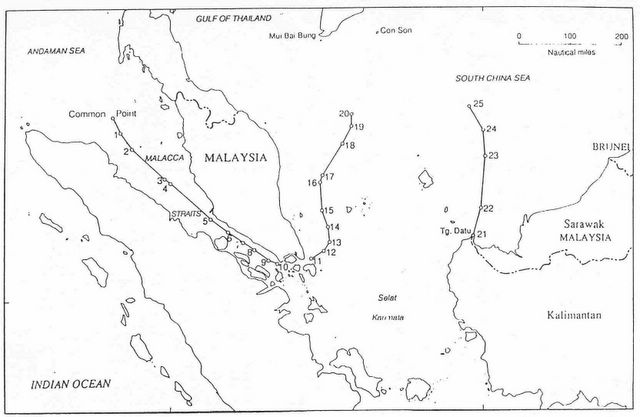

Figure 3.a Indonesia-Malaysia Maritime Boundaries


Maritime Boundary in Celebes Sea: Status and Problems
According to Villanueva (2005), the overlapping claims of territorial sea boundary, EEZ boundary and Continental Shelf boundary around Ambalat area or Celebes Sea have not yet been fully agreed. These have to be established through a bilateral negotiation between Indonesia and Malaysia. Jinangkung (2005)7 stated that Indonesia is actually ready to conduct any negotiation and even already started the negotiation on 22 March 2005 with Malaysia. Even though it seemed to be related to Ambalat case, he asserted that the negotiation was a scheduled negotiation and would generally discuss Indonesia-Malaysia unresolved boundaries in the three locations: Malacca Strait, South China Sea and Celebes Sea.
Ambalat
Many people do not precisely aware the position of Ambalat. Some even do not realize that Ambalat is not an island but water area/block located in the east of Borneo. Besides Ambalat, the block is also known as Block ND6 and ND7.
According to discussion on this matter in an internet-based community, RSGIS Forum, Ambalat is a block located in the area with coordinates of 118°15'21" - 118°51'15" E and 2°34'7" - 3°47'50" N. Having assumed that the coordinate is accurate, Ambalat lays from South to North at a distance of 65 km and 135 km from West to East. This also means that the block situates bellow the border line crossing Sebatik Island. Relative to Sipadan and Ligitan, Ambalat situates closer to Borneo. Two figures bellow respectively show the location of Ambalat and its position relative to Sipadan and Ligitan.


It is worth noting that the ICJ’s decision to grant Sipadan and Ligitan to Malaysia may change the configuration of Malaysia’s baselines. This can influence maritime zone it may claim. In the other words, it is highly possible for Malaysia to claim larger maritime zones southward to Indonesia. This, according to some sources, is one of the strengths for Malaysia to claim Ambalat.

Conflict Resolution: A Rough Idea
As previously mentioned, a bilateral mutual agreement between Indonesia and Malaysia is required to resolve conflict on boundary case. It is obvious that Ambalat case is a maritime conflict because Indonesia and Malaysia claim the same maritime zones (overlapping claim) where the block situates. Villanueva (2005) asserted that this is not the case of full sovereignty but limited sovereignty to explore and exploit maritime zone and natural resources deposited there. This is different compared to the case of the ownership of an island.
Before deciding to start a negotiation, Indonesia obligates to conduct comprehensive studies, which technically has to be initiated by the National Coordinating Agency for Surveys and Mapping (Bakosurtanal) and The Indonesian NAVY’s Hidro-Oceanographic Office (Dishidros TNI-AL) with coordination with the Department of Foreign Affairs.

Following are technical steps that might be considered in resolving Ambalat case.
  1. Baselines Definition
    It has to be anticipated that Malaysia may change its baseline configuration because Sipadan and Ligitan are now officially theirs. Defining Indonesia and Malaysia’s baseline in Celebes Sea is the first step to do as reference for measuring maritime zones. Indonesia, will, of course, preserve its archipelagic baselines.
  2. Definition of EEZ and Continental Shelf Boundary
    The second step is to define the boundary for EEZ and Continental Shelf. It will be found that Ambalat situates in EEZ and Continental Shelf of both States. The case deals with Continental Shelf since it relates to the exploration and exploitation of seabed.

  3. Maritime Boundary Delimitation
    The overlapping claim in the EEZ and Continental Shelf requires maritime boundary delimitation. It has been widely accepted to employ equidistance/median line to generate a boundary line, at least as a starting point. After that, it needs to consider contributing factors/aspects to achieve an equitable solution. Factors that need to be considered are proportion of coastal length involved, and socio-economic development of both sides.

  4. The possibility to establish Joint Development Area
    If the delimitation divides Ambalat into two different parts, each country can only explore and exploit its own part. Another possibility is to establish a Joint Development Area, similar to what agreed by Indonesia and Australia in the Timor Gap. The urgent matter that needs to agree upon is the management and sharing rules for each side.

Technical steps described above can be done by employing in situ survey or cartographically using nautical chart and satellite image in a sufficient scale.

Closing Remarks
Having considered the above analysis, it can be concluded that:
  1. Ambalat case is a limited sovereignty conflict because both Indonesia and Malaysia try to claim the same maritime zone (overlapping claim).

  2. A good understanding in term of science, technique and law is essential, not only for government officials but also ordinary people from both sides, to avoid emotional decision.

  3. This requires synergy among related departments, agencies, boards, etc. to comprehensively study the case before deciding to negotiate the case bilaterally or submitting the case to the International Court of Justice.

The case involving Sipadan, Ligitan, Ambalat and other similar cases related to International Boundary should have reminded Indonesia, as a nation, to seriously pay attention to maritime boundary delimitation. Another urgent step is to list small islets all over Indonesian Archipelago, and to name (toponim) every single islet. This, actually, has been conducted by the Department of Marine Affairs and Fisheries since quite a long time. To speed up the process, as opined by Wikantika (2005) Remote Sensing technology can be employed using satellite images. By finishing these all urgent “homework”, hopefully Indonesia gains more strength to preserve its sovereignty and can negotiate confidently whenever a case regarding maritime boundary arises.

Footnotes

1Delivered in an open discussion by Indonesian Students at UNSW, Sydney, 29 March 2005
2A Lecturer at Department of Geodetic Engineering, UGM, currently studying technical aspect of International Maritime Boundaries
3see also http://www.icj-cij.org/icjwww/ipresscom/ipress2002/ipresscom2002-39_inma_20021217.htm about the ICJ’s judgment on this case
4Detail regulation for each maritime zone can be found in UNCLOSS III document. Online access: www.un.org/Depts/los/convention_ agreements/texts/unclos/unclos_e.pdf
5Three types of baselines: normal baseline, straight baseline, and archipelagic baseline. The last type is applicable to Indonesia because it is an archipelagic state.
6Datum is a reference position for an object on earth. A map must have an official datum and is scientifically acceptable in an area. Two maps used together for common purpose must have the same datum.
7L. Amrih Jinangkung is a staff of the Indonesia’s Department of Foreign Affairs, Directorate of Treaties on Political Security and Territorial Affairs. Communication with author was done by email.

References
Forbes, V. Louis, (2001), Conflict and Cooperation in Managing Maritime Space in Semi-Enclosed Seas, University of Hawaii Press
Prescott, Victor (2004), Maritime Delimitation in Southeast Asia: The Case of Indonesia
Schofield, C. (2003) Maritime Zones and Jurisdiction, 2003 ABLOS Conference, available: http://www.gmat.unsw.edu.au/ablos/ABLOS03Folder/SESSION3.PDF
Syarif, Laode M., (2005), Pesan buat Syed Hamid Albar, Kompas,12 maret 2005
Tarmansyah, Umar S., (2003), Lepasnya P. Sipadan Dan P. Ligitan Sebuah Pelataran Kewaspadaan, Buletin Balitbang Dephan No 10
Villanueva, Klaas J., (2005) Satu Pandangan/Ulasan: Sengketa Wilayah ZEE Dan Wilayah Landas Kontinen di Ambalat
Wikantika, Ketut, 2005, Mereinventarisasi Pulau-pulau Terluar Indonesia Citra Satelit Kurangi Biaya Survei, Pikiran Rakyat, 17 maret 2005

More...